


Dr. Muhammad, AZHAR
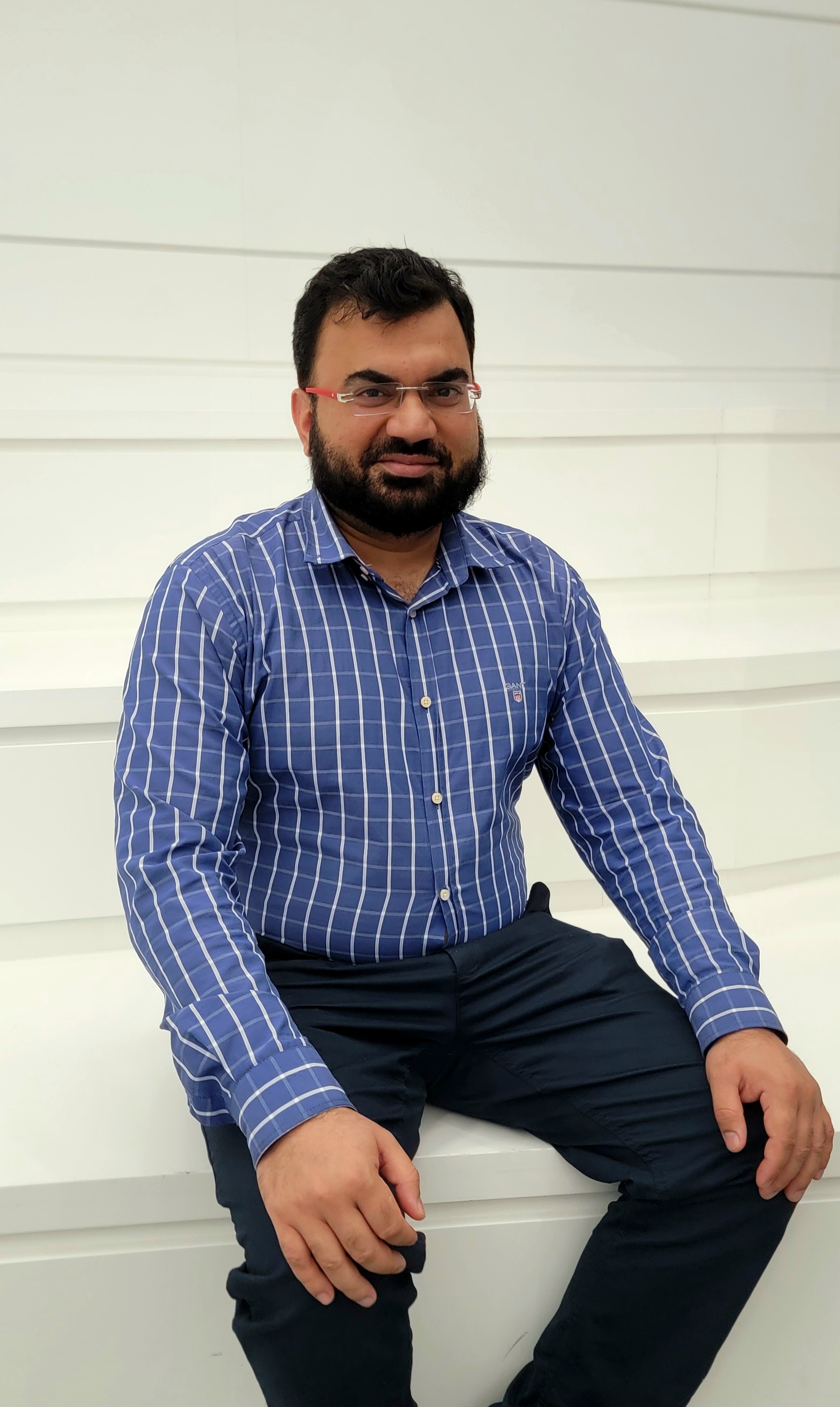
He has experience across academia and industry, including roles at Sofnix Private Limited and Turnotech Private Limited in Pakistan and Welltime Ltd. in the U.K. He holds a PhD in Machine Learning and Data Mining from Shenzhen University, China, and an MS in Virtual Reality from Sejong University, South Korea. Before joining HKSYU in 2023, he served as a Research Professor in Chosun University, South Korea, contributing to projects on 3D dental X-ray reconstruction and osteoporosis prediction using multimodal data.
As a dedicated AI educator, Dr. Azhar has taught diverse courses from introductory programming to advanced machine learning. He received the University’s 2024–2025 Teaching Excellence Award and achieved top student evaluation scores for consecutive semesters.
His research appears in Applied Soft Computing, Applied Intelligence, Applied Intelligence, IEEE Access, and other high-impact journals. He leads funded projects including “MindMate,” a generative AI system for personalized mental health, and a QESS grant on AI-based language learning.
Courses Taught
- Introduction to Machine Learning (ML)
- Deep Learning
- Computer Vision with Deep Learning
- Computer Organization and Architecture (COA)
- Digital Humanities: Theories and Methods
- Introduction to Database Systems
- Computer Programming as Problem Solving
- Predicting Human Behavior with Big Data
- Writing Your First Apps Using Python Programs
- Introduction to Data Science
- Python for Data Science
- Introduction to Data Mining
Area of Interest
- Machine Learning
- Deep Learning
- Data Mining
- Computer Vision
- Natural Language Processing
Academic Qualifications
- PhD (Machine Learning and Data Mining) Big Data Institute, Shenzhen University, Shenzhen, China
- MS (Virtual Reality) Intelligent Media Lab, Sejong University, South Korea
- BS (Computer Science) National University of Computer and Emerging Sciences, Islamabad, Pakistan
Funded Projects
- HKSTP (HK$100,000) – Principal Investigator (PI)
Project Title: A Health Buddy Bot for Enhancing the Well-Being of Hong Kong Citizens
Funding Body: Hong Kong Science & Technology Parks Corporation (HKSTP/24-1596)
This project develops an AI-powered wellness chatbot that promotes holistic well-being through data driven dialogue and personalized health recommendations.
- URG (HK$40,000) – Principal Investigator (PI)
Duration: January 2024 – December 2026
Project Title: MindMate: A Generative AI System for Personalized Mental Health Recommendations through Chat Interaction
This project designs a transformer-based conversational AI to provide empathetic mental health support and personalized guidance.
- RIS (HK$15,000) – Principal Investigator (PI)
Duration: January 2024 – December 2027
Project Title: Automatic Suggestions Generation by Generative Artificial Intelligence Based on Customer Reviews
This project focuses on developing a generative AI model that converts customer feedback into actionable business insights.
- QESS Project 1 (HK$13,142,800) – Leader of Technical Development Team
Duration: January 2026 – December 2028
Project Title: Developing an AI-Enhanced Teaching Resource Hub for the Self-Financing Higher Education Sector
- QESS Project 2 (HK$2,382,950) – Leader of the Technology Support Team
Duration: January 2025 – December 2026
Project Title: Empowering Language Competence and Professional Communication through an AI-based Language Laboratory (ALL)
This project develops an AI-enabled language learning system that provides interactive feedback to enhance communication competence.
- QESS Project 3 (HK$3,936,800) – Co-Leader of Technical Development Team
Duration: January 2026 – December 2027
Project Title: Enhancing Students’ Emotional Wellness and Resilience in Post-Secondary Institutions
This project implements AI-based predictive analytics for monitoring and enhancing student emotional resilience.
- External Fund – Korea (₩30,000,000) – Team Member
Duration: January 2022 – December 2023
Project Title: Classification of Dental Diseases through Panoramic Radiographs
Developed deep learning models for dental disease classification using panoramic radiographs, focusing on model optimization and validation.
Publications
Refereed Journal Papers
- Azhar, M., Amjad, A., Arman, M., & Dewi, D. A. (2026). Multimodal Emotion Detection in Low-Resource Languages Using Lightweight Transformer Architectures: A Dual-Level Fusion Framework Integrating DistilBERT, CNN-BiGRU, and MobileViT for Efficient Real-Time Urdu Affective Computing. Information, 17(5), 458. https://doi.org/10.3390/info17050458 (IF: 2.9, Q2)
- Azhar, M., Arman, M., Amjad, A., Dewi, D. A., Ahmad, M. U., Hussain, S. (2026) Explainable Transformer-Based Framework for Suicide Risk Detection: Deep Learning with Interpretability for Mental Health Crisis Identification. Information. 2026; 17(5):448. https://doi.org/10.3390/info17050448 (IF: 2.9, Q2)
- Ali, Z., Brottier, Z. R., Al-Khayri, J. M., Azhar, M., Al-Dossary, O. M., Al-Dalali, S., ... & Almaghasla, M. I. (2026). Storage Temperature and Quality Dynamics of Sun-Aged Red Date Vinegar Beverage. Frontiers in Nutrition, 13, 1839712. https://doi.org/10.3389/fnut.2026.1839712 (IF: 5.1, Q1)
- Azhar, M., & Sabir, E. (2026). Benchmarking Robust Machine Learning Models Under Data Imperfections in Real-World Data Science Scenarios. Journal of Data Science, 2026(1), 38-59. https://doi.org/10.61453/jods.v20260103 (Q3)
- Azhar, M., & Mehwish, U. (2026). Federated Learning for Privacy-Preserving Data Science: Performance, Efficiency, and Scalability Analysis. Journal of Data Science, 2026(1), 81-101. https://doi.org/10.61453/jods.v20260105 (Q3)
- Misinem, Azhar, M., & Chan, K. L. (2026). Adaptive Data-Centric Artificial Intelligence for Robust Decision-Making in Dynamic Environments. Journal of Data Science, 2026(1), 1-14. https://doi.org/10.61453/jods.v20260101 (Q3)
- Abdulrahman, R., Jamil, A., Amjad, A., Hussain, S., Azhar, M., Aslam, Z., ... & Waqas, M. (2025). Automated Deep Learning Approaches for Multimodal Emotion Recognition: A Review of Fusion Strategies, Modalities and Architectures. Machines and Algorithms, 4(3), 198-214. https://doi.org/10.66108/mna.v4i3.103
- Javeed, M. U., Fatima, S., Zahoor, M. M., Azhar, M., Raza, Z., Aslam, S. M., & Nauman, M. (2025). MindMate: An Emotion-Aware Generative AI System for Personalized Mental Health Support. Journal of Computing & Biomedical Informatics, 10(1). (Q4)
- Azhar, M., Amjad, A., Dewi, D. A., & Kasim, S. (2025). A Systematic Review and Experimental Evaluation of Classical and Transformer-Based Models for Urdu Abstractive Text Summarization. Information, 16(9), 784. https://doi.org/10.3390/info16090784. (IF: 2.9, Q2)
- Azhar, M.*, Amjad, A., Farid, G., Dewi, D. A., & Batumalay, M. (2025). Efficient Transformer-Based Abstractive Urdu Text Summarization Through Selective Attention Pruning. Information, 16(11), 991. https://doi.org/10.3390/info16110991 (IF: 2.9, Q2)
- Cheemaa, A. S., Azhar, M.*, Arif, F., ul haq, Q. M., Sohail, M., & Iqbal, A. (2025). EGPT-SPE: story point effort estimation using improved GPT-2 by removing inefficient attention heads. Applied Intelligence, 55(15), 994. https://doi.org/10.1007/s10489-025-06824-4 (IF: 3.5, Q2)
- Chen, J., Xu, Y., Li, X., & Azhar, M. (2025). A mode-partitioned gamma mixture model estimation method for large-scale multimodal data. Big Data Mining and Analytics, 9(1), 4-22. https://doi.org/10.26599/BDMA.2025.9020045 (IF: 6.2, Q1)
- Farid, G., Bilal, M., Zhang, L., Alharbi, A., Ahmed, I., & Azhar, M. (2025). An improved deep Q-Learning approach for navigation of an autonomous UAV agent in 3D Obstacle-Cluttered environment. Drones, 9(8), 518. https://doi.org/10.3390/drones9080518 (IF: 4.8, Q1)
- Shakeel, H., Akram, M., Javeed, M. U., Azhar, M.*, Aslam, S. M., & Mumtaz, M. T. (2025). LncRNAs Disease: A text mining Approach to Find the role of lncRNA in Aging. Journal of Computing & Biomedical Informatics, 9(01). (Q4)
- Khan, M., Hussain, S., Amjad, A., Jamil, A., Azhar, M., Usman, M., ... & Akbar, M. H. (2025). Enhancing human-centric interaction: A deep learning approach for robust facial expression recognition and intensity estimation. Spectrum of Engineering Sciences, 3(10), 1976-1985. https://doi.org/10.5281/zenodo.17811338
- Azhar, M., Perveen, S., Iqbal, A., & Lee, B. (2024). IDRandom-Forest: advanced random forest for real-time intrusion detection. IEEE Access. https://doi.org/10.1109/ACCESS.2024.3443408 (IF: 3.6, Q1)
- Khan, S. U., Khan, M. A., Azhar, M., Khan, F., Lee, Y., & Javed, M. (2023). Multimodal medical image fusion towards future research: A review. Journal of King Saud University-Computer and Information Sciences, 35(8), 101733. https://doi.org/10.1016/j.jksuci.2023.101733 (IF: 6.1, Q1)
- Zia, S., Azhar, M.*, Lee, B., Tahir, A., Ferzund, J., Murtaza, F., & Ali, M. (2023). Recognition of printed Urdu script in Nastaleeq font by using CNN-BiGRU-GRU based encoder-decoder framework. Intelligent Systems with Applications, 18, 200194. https://doi.org/10.1016/j.iswa.2023.200194 (IF: 4.3, Q1)
- Yasin, A., Fatima, R., Wen, L., Afzal, W., Azhar, M., & Torkar, R. (2020). On using grey literature and google scholar in systematic literature reviews in software engineering. IEEE access, 8, 36226-36243. (IF: 3.4, Q1)
- Zhang, X., He, Y., Jin, Y., Qin, H., Azhar, M., & Huang, J. Z. (2020). A Robust k‐Means Clustering Algorithm Based on Observation Point Mechanism. Complexity, 2020(1), 3650926. https://doi.org/10.1155/2020/3650926 (IF: 1.7, Q1)
- Trinh, T., Wu, D., Huang, J. Z., & Azhar, M. (2020). Activeness and loyalty analysis in event-based social networks. Entropy, 22(1), 119. https://doi.org/10.3390/e22010119 (IF: 2, Q2)
- Azhar, M.*, Huang, J. Z., Masud, M. A., Li, M. J., & Cui, L. (2020). A hierarchical Gamma Mixture Model-based method for estimating the number of clusters in complex data. Applied Soft Computing, 87, 105891. https://doi.org/10.1016/j.asoc.2019.105891 (IF: 8.26, Q1)
- Tahir, M., Li, M., Zheng, X., Carie, A., Jin, X., Azhar, M., ... & Hulio, Z. H. (2019). A novel network user behaviors and profile testing based on anomaly detection techniques. International Journal of Advanced Computer Science and Applications, 10(6), 305-324. https://dx.doi.org/10.14569/IJACSA.2019.0100641 (IF: 0.9, Q3)
- Azhar, M., Li, M. J., & Zhexue Huang, J. (2019). A hierarchical gamma mixture model-based method for classification of high-dimensional data. Entropy, 21(9), 906. https://doi.org/10.3390/e21090906 (IF: 2, Q2)
- Baik, S. W., Azhar, M., Fahad, M. S., Mehmood, I., Gu, B. W., Par, W. J., ... & Jang, Y. (2015). Flowchart Based Storyboard System for Authoring Visual Contents in Mixed Reality Space. International Journal of Electronics and Electrical Engineering, 3(3), 240-244. https://doi.org/10.12720/ijeee.3.3.240-244
- Azhar, M., Sajjad, M., Mehmood, I., Gu, B. W., Kim, W., Han, J. S., ... & Baik, S. W. (2014). Real time distributed content rendering technique based on agent-mediator communication framework for multi-display systems. IERI Procedia, 6, 2-7. https://doi.org/10.1016/j.ieri.2014.03.002
Authored books or book chapters
- Azhar, M., Shabbir, I., Ali, M. S., Farid, G., Arif, H., & Fatima, R. (2026). Integrating Agentic AI Ethically Into Geriatric Healthcare: A Framework for Frailty Monitoring With Transformer Models and Wearable Technology. In Ethical AI Applications for Software Engineering and Development (pp. 245-274). IGI Global Scientific Publishing.
- Saber, A., Emara, T., Mahmud, M. S., Azhar, M., & Hassan, E. (Eds.). (2025). Advancements in speech processing for human-computer interaction. IGI Global. https://www.igi-global.com/book/advancements-speech-processing-human-computer/370394
- Fahad, Azhar, M., Sajjad, M., Mehmood, I., Kwon, S. I., Lee, J. W., & Baik, S. W. (2014). Comparative Analysis of Graphic Contents Rendering Techniques in a Multi-view System through Agent-Mediator Based Communication. In Ubiquitous Information Technologies and Applications: CUTE 2013 (pp. 573-579). Berlin, Heidelberg: Springer Berlin Heidelberg.
Refereed Conference Papers
- Azhar, M.*, Amjad, A., Mahmud, M. S., Sadiq, M., Ali, Z., & Hussain, S. (2025, December). Predictive Modeling of Alzheimer’s Disease Progression Using Multiomics and Neuroimaging Data with Transformer Architectures on the ADNI Dataset. In 2025 International Conference on Frontiers of Information Technology (FIT) (pp. 1-6). IEEE
- Shabbir, I., Azhar, M.*, Ali, M. S., Ling, C. K., Wattoo, W. A., & Iqbal, A. (2025, August). Caries Detection in Dental Imaging Using Vision Transformer and Explainable AI. In 2025 International Conference on Artificial Intelligence for Sustainable Innovation (AI-SI) (pp. 1-6). IEEE.
- Iqbal, A., Azhar, M.*, Ali, M. S., Usman, M., Wattoo, W. A., & Farhan, M. (2025, August). Smart Fire Vision: Advancing Fire Detection in Smart Cities by Efficient Hybrid Deep Learning Technique. In 2025 International Conference on Artificial Intelligence for Sustainable Innovation (AI-SI) (pp. 1-6). IEEE.
- Javeed, M. U., Ali, M. S., Iqbal, A., Azhar, M.*, Aslam, S. M., & Shabbir, I. (2024, December). Transforming Heart Disease Detection with BERT: Novel Architectures and Fine-Tuning Techniques. In 2024 International Conference on Frontiers of Information Technology (FIT) (pp. 1-6). IEEE.
- Hussain, K., Azhar, M.*, Lee, B., Iqbal, A., Affan, M., & Khan, S. U. (2023, December). ASAnalyzer: Attention based sentiment analyzer for real-world sentiment analysis. In 2023 International Conference on Frontiers of Information Technology (FIT) (pp. 184-189). IEEE.
- Ali, M. S., Azhar, M.*, Masood, S., Lee, B., Iqbal, T., & Amjad, A. (2023, December). Efficient Video Summarization with Hydra Attentive Vision Transformer. In 2023 International Conference on Frontiers of Information Technology (FIT) (pp. 196-201). IEEE.
- Ahmad, R. A., Azhar, M.*, & Sattar, H. (2022, December). An image captioning algorithm based on the hybrid deep learning technique (CNN+ GRU). In 2022 International Conference on Frontiers of Information Technology (FIT) (pp. 124-129). IEEE.
- Azhar, M., & Li, J. L. (2017). IniceMPRO: Identify the Number of Clusters and Initial Cluster Centers using Multi Layer GMMs. In The 5th CCF BIG DATA Conference.
- Azhar, M., Malik, F. R., Sajjad, M., Irfan, M., Gu, B. W., Park, W. J., & Baik, S. W. (2014). VIP-emulator: to design interactive architecture for adaptive mixed reality space. In Proceedings of the International Conference Data Mining, Civil and Mechanical Engineering (ICDMCME 2014), International Institute of Engineers, Indonesia.
Professional Experiences
- Research Professor, IT Convergence, Department of Computer Science, Chosun University, South Korea (2022-2023)
- Assistant Professor, Department of Computer Science, Comsats University Islamabad, Pakistan (2020-2022)
- Research Scholar, Big Data Institute, Shenzhen University, Shenzhen, China (2015-2020)
- Lecturer, Department of Computer Science, Comsats University Islamabad, Pakistan (2014-2015)
- Research Assistant, Intelligent Media Lab, Sejong University, South Korea (2012-2014)
- Visiting Lecturer, Huazhong University of Science and Technology, China
- Software Engineer (Remote), Welltime Pvt. Limited, UK (2012-2014)
- IOS and android Application developer, Turnotech Pvt. Limited, Islamabad (2011-2012)
- Software Engineer, Sofnix Private Limited, Islamabad (2011-2012)
Achievements
-
2024–2025 Hog Kong Shue Yan University Teaching Excellence Award Winner
Scholarly and Community Services
- Life-time member of Minhaj-ul-Quran International (Social and educational NGO in 57 countries)
- Member of Hong Kong Computer Society
- Reviewer of the following journals:
- Information Sciences
- Neural Computing and Applications
- Applied Soft Computing
- Computers in human behavior
- Intelligent systems with applications
- IEEE ACCESS
- Entropy
- Information Sciences